Announcement

Collapse
No announcement yet.

North Sea News

Collapse
X
  • Filter
  • Time
  • Show
Clear All
new posts

  • Aviafora Newsdesk
    replied


    Seating by Size to be Introduced on North Sea Flights

    New rules are to be introduced on the size of oil workers travelling to and from offshore installations by helicopter.

    Passengers with a shoulder width of 22 inches or more will be classed as "extra broad" and will have to sit next to a similarly large helicopter window.

    It follows a Civil Aviation Authority review of helicopter safety.

    Concerns were raised about larger passengers being able to escape from a crashed aircraft quickly.
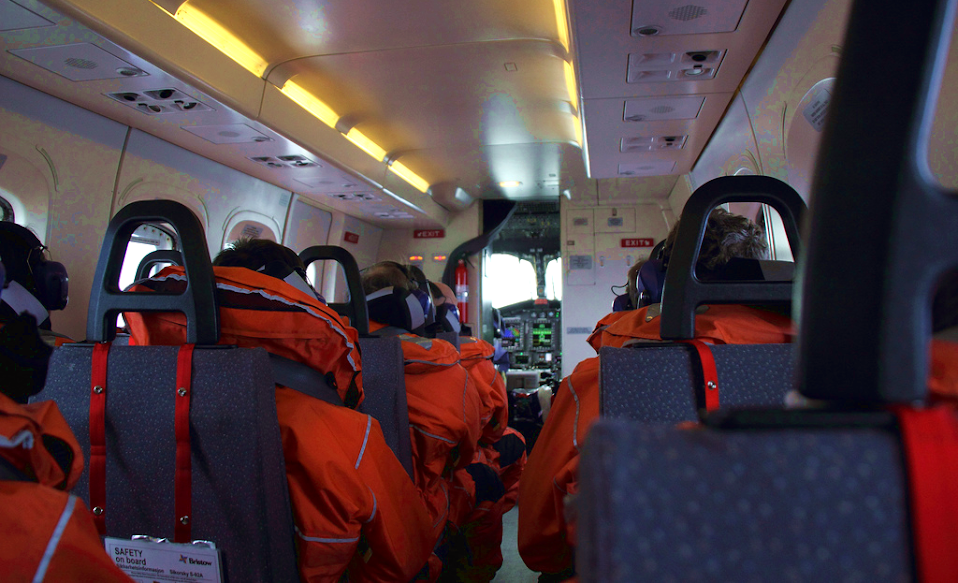


    Passengers with a shoulder width exceeding 22 inches will be assigned specific seats close to large windows

    The changes come after a study revealed the average oil worker had risen in weight by close to 20% over the past 30 years.

    There were concerns that size had become a risk factor in helicopter accidents, with larger workers finding it harder to leave helicopters during emergencies due to the size of the exits.

    Now those classed as "extra broad" will have to sit next to a window with a diagonal width of at least 22 inches.

    The offshore safety body Step Change said at least 25% of helicopter windows meet the new criteria.

    It said there would be ongoing discussion about how, when and where passengers would be measured.

    The move follows other changes to the helicopter safety regime - including strict new clothing rules for passengers introduced last week.
    http://www.bbc.co.uk/news/uk-scotlan...tland-29502334

    Leave a comment:


  • Aviafora Newsdesk
    replied
    New Offshore Operator Group to Advocate Safety

    Offshore helicopter operators have clearly been hurt by events over the past few years. A series of accidents – mostly but not exclusively on the UK side of the North Sea – that culminated in the August 2013 fatal crash of a CHC Scotia-operated Super Puma near Shetland have led to unprecedented scrutiny of the sector’s safety record.

    Aside from the regular accident investigations and fatal accident inquiries in the courts, UK regulator the Civil Aviation Authority (CAA), as well as politicians, have weighed in with separate reports into offshore helicopter safety.

    The industry has not stood still, however. In the wake of the Shetland accident, the North Sea’s big three – Avincis (parent of Bond Offshore Helicopters), Bristow Group and CHC Helicopter – came together to launch the Joint Operators Review (JOR), which aimed to drive safety improvement through sharing best practice.

    But now the industry’s ambitions have grown. A new global safety organisation called Heli Offshore is to formally launch later this month. Its founder members include the three operators mentioned above, plus fellow US firms PHI and Era Group. In all, around 80% of the global offshore fleet is accounted for by the five companies.

    Based in London, Heli Offshore will be led by Gretchen Haskins, an expert in human factors and former board member and safety director at the CAA and UK air navigation service provider NATS.

    A small room inside a serviced office building in central London is the current home of the fledgling organisation. A rabbit warren of identical-looking corridors leads to its meeting room – signposted by a piece of printed A4 paper taped to the door. Inside, large photographs of the operators’ helicopters decorate the walls, and on the window ledge there are several perspex plaques commemorating the occasion of the first board meeting, held on 18 September.

    “It’s quite a special thing – the CEOs are putting aside competitiveness to join together on this. We wanted to mark the date of the first board meeting,” says Haskins.

    Although the mundane business of ushering a non-for-profit limited company into being formed part of the discussions at the first meeting, the board also quickly got down to the task at hand. “The JOR workstreams are already up and running and we want to make sure we hit the ground running on the key safety priorities,” says Haskins.


    Plans to tackle each of those priorities will be drawn up – addressing them not through what Haskins describes as “best endeavours”, but through “a clear, resourced plan with dates and deliverables” that will serve to “mobilise those five companies”. Previously the JOR relied on ad hoc resource from the three members.

    The workstreams are those already developed by the JOR, dealing with automation, training, manufacturing, emergency response and safety information, with another focused on health and usage monitoring system (HUMS) data. “[HUMS] is built to be a safety tool – we need to make sure it gets used worldwide in the best possible way,” Haskins says.

    The analysis of a huge amount of data drawn from HUMS, flight management systems and line-orientated safety audits will also form a core part of its work.

    Although a global organisation, Heli Offshore’s intention is not to push for uniform regulation across every jurisdiction. However, says Haskins, if a country’s proposed rules appear inadequate, the industry now has a platform from which to raise questions and present dissenting views.

    Heli Offshore’s core membership will be drawn from operators themselves, with other interested parties allowed to sign up as “client” or “alliance” members. This includes the four Western helicopter manufacturers – who Haskins is confident will join as it represents a “very valuable” opportunity “to hear from operators what would make the biggest difference to them”. Those travelling in the rear of the helicopters will also get a seat at the table, with trade unions also welcome to join.

    Despite recent history, Haskins is a little equivocal when it comes to the question of whether or not offshore helicopters operators have a safety problem. “Compare it to walking across the street – well, it’s safer than that,” she says. “Compare it to commercial aviation and there’s some way to go. But we want to take on that challenge.”

    One of the board’s goals, she says, is to ensure that the offshore accident rate is at least equal to, or ideally better than, that of the commercial aviation industry.

    She also rejects a suggestion made by UK politicians that profit motives may be adversely affecting helicopter safety, noting that although the organisation “won’t ignore it” she has “not seen evidence” to support the allegation.

    Haskins stresses that Heli Offshore is not there to police the industry. “I’m more into safety improvement and achieving those goals rather than holding someone’s feet to the fire,” she says. “The biggest safety advances come when people are working together to achieve those aims.”

    This collaboration is perhaps the unique feature of Heli Offshore. Even if one operator believes their priorities are different, “they don’t change that much from one company to another, or even from one country to another”. And the huge “mobilisation” of resources across the companies will lead to “new ways of solving the problems”.

    Haskins describes herself as “genuinely excited” by the “golden opportunity” presented by Heli Offshore and its “structured, clear remit to share, develop and implement best practice”.

    “What I see from the CEOs is a real ownership of the issue and a commitment to the safety of the passengers and crew on their aircraft.

    “Once you have that, you have what you need to drive consistently higher levels of safety,” she says.
    http://www.flightglobal.com/news/art...ety-404343/​

    Leave a comment:


  • HeliHub News
    replied


    Bond Preparing for Closure of Blackpool Airport

    British operator Bond has been supporting gas rigs on the Irish Sea since at least 1978 when they took delivery of an initial pair of SA365C Dauphins. In reality very little has changed over the years apart from a short term change of operator – Bond still fly Dauphins from Blackpool, but these days they are 365N3 models.

    On Monday, Blackpool Airport owners Balfour Beatty issued a statement saying “On 28 August 2014, we announced our intention to find a buyer for the airport operating company. The airport operations have been making a loss for a number of years and we are currently exploring a number of options in an attempt to secure the future of the airport. We regretfully confirm that if no agreement can be reached before 7 October 2014 which ensures the viability of its operations, then it is likely that the airport operations will close. In this event, we expect that the last commercial flights will take place on Wednesday 15 October 2014.”

    Susan Kendrick, Corporate Affairs Manager of the airport told us “We are currently exploring a number of options in an attempt to secure the future of the airport, this includes working closely with interested parties such as Bond Offshore Helicopters”, which adds nothing new to Monday’s statement

    Meanwhile, Bond have confirmed to HeliHub.com that they are working with Blackpool airport and their customers, to ensure continuity of services. They also confirmed they are currently in discussions with a number of alternative airfields, although in reality that probably boils down to Liverpool, Liverpool and Liverpool (in that order).

    Outside possibilities could include:
    • Walney Island – Difficult road access
    • Warton – Military aircraft manufacturing facility owned by BAE Systems. Seems unlikely but continues to be used as base for Lancashire Police helicopter, now part of NPAS
    • Woodvale – Run by the military, and was used as base for Merseyside Police helicopter
    http://helihub.com/2014/10/01/uk-bon...kpool-airport/

    Leave a comment:


  • Aviafora Newsdesk
    replied


    Oil & Gas UK Hosts Safety Briefing

    The continuing steps being taken to improve further the safety of offshore helicopter flights will be outlined to the oil and gas sector on Thursday (October 2) in a meeting organised by Oil & Gas UK which will be held at the Aberdeen Exhibition and Conference Centre.

    Seven months after the UK Civil Aviation Authority (CAA) published its ‘CAP1145’ report containing a series of actions and recommendations for helicopter safety, Oil & Gas UK is hosting a helicopter safety breakfast briefing at Aberdeen Exhibition and Conference Centre.

    Mark Swan, group director, safety and airspace regulation with the CAA, will give a talk about the report at an event entitled: "Safety in the North Sea - What is the future for our Helicopters?" sponsored by Petrotechnics.

    Robert Paterson, health, safety and employment issues director at Oil & Gas UK said: “Understandably there has been a significantly increased focus on post-incident safety and survivability. There is, however, a considerable amount of work being undertaken to ensure helicopter travel is even safer. Improvements in safety are being identified, assessed and delivered in a collaborative effort involving helicopter operators, aircraft manufacturers, regulators, oil and gas companies, and groups that represent passengers. Hopefully this breakfast briefing will go some way to help further restore confidence in the safety of helicopter operations.”

    Following Mr Swan’s talk, he will participate in a question and answer session together with the following panellists: Mark Abbey, Regional Director Western North Sea, CHC Helicopter; Luke Farajallah, Managing Director, Bond Offshore Helicopters Ltd; and Tim Glasspool, Head of Flight Operations (Europe), Bristow Helicopters Ltd.

    Mr Swan added: “The safety of those who use offshore helicopter flights is our absolutely priority. When we published our review of the area in February a lot of the attention was understandably focused on changes around survivability, but actually the vast majority of the actions and recommendations in our report are aimed at the prevention of accidents through improved helicopter design, operations, and aspects of training and maintenance.”
    http://www.oilandgasuk.co.uk/news/news.cfm/newsid/1067

    Leave a comment:


  • Aviafora Newsdesk
    replied
    No Skirts Offshore

    Women travelling to and from offshore oil and gas installations are now banned from wearing skirts and dresses as part of new safety measures.

    Passengers will also have to wear three layers of clothing under their survival suits in winter, and two in summer.

    The standardised clothing policy is designed to improve the chance of survival for workers if helicopters have to ditch into the sea.

    Shorts, hoodies, high-heels and sandals have also been banned.

    The offshore helicopter industry has been trying to improve safety since four people died when a helicopter ditched off Shetland in August last year.

    The offshore union the RMT said it welcomed the new rules because they created clarity for those working in the industry.
    http://www.bbc.co.uk/news/uk-scotlan...nd-29428825​

    Editor's Note:
    The BBC have not made clear from where this ruling has emerged. In any case it would surely take 'Houdinian skills' for a woman to wear a skirt or dress beneath the current regulation immersion suits!

    Leave a comment:


  • Aviafora Newsdesk
    replied


    Bond Pilots Suspended

    Two pilots have been suspended and an investigation launched after a North Sea helicopter landed on the wrong oil rig.

    The Bond-operated S-92 helicopter with one passenger on board had been set for the Buzzard platform – about 60 miles north of Aberdeen. But instead it made an unscheduled landing on the Nexen-operated Ensco 120 jack-up rig – about nine nautical miles away. Last night, Bond confirmed two employees had been removed from the flight roster while an investigation takes place.

    One concerned oil worker said: “When this chopper landed on the rig the radio operator called the helicopter and said ‘can we help you?’. They replied ‘we appear to have landed on the wrong rig’.


    A Bond-operated S-92

    “Most helicopter accidents occur on approach or departure – you must have a crew on the rig ready to receive the helicopter and a standby boat there to offer help if needed.

    When a chopper is approaching a rig you are not allowed to move cranes – the rig was fully operational with cranes working.

    “Most of the time the crane operator is the helicopter landing officer so that takes care of the problem.”

    The aircraft, which can potentially carry up to 19 passengers, is understood to have left Aberdeen Airport at 5.30pm on Friday.

    It made a number of scheduled landings before arriving at the unprepared Ensco 120 rig at around 7pm.

    The oil worker added: “Lives have been put at risk because of this – it’s unbelievable that in this day and age they could have got this so wrong.”

    Jake Molloy, regional organiser of the RMT union, said it was difficult to understand how such a mistake could have been made.

    “We have had landings on the wrong deck before, but they have normally been very close to one another,” he said.

    “Nine miles apart is difficult to comprehend when the pilots have to call in to the helideck asking for clearance, and the helicopter landing officer should have it in sight.

    “This is an area that has to be looked at carefully and hopefully lessons can be learned.”

    Helicopter safety campaigner and north-east MSP Lewis Macdonald described the incident as “concerning”.

    He said: “Clearly, everybody who uses helicopters – and their families – needs to have confidence in the systems and procedures used by companies like Bond and anything that undermines that confidence must be investigated urgently.


    “An incident such as this is bound to throw up questions and concerns.”

    A spokesman for Bond confirmed two crewmen had been suspended as a result of the incident.

    He said: “We can confirm an S-92 helicopter landed safely on the deck of a platform which was not on the original flight plan.

    “Both pilots have been removed from the flying roster pending an investigation.”
    http://www.energyvoice.com/2014/08/p...nds-wrong-rig/

    Leave a comment:


  • Aviafora Newsdesk
    replied


    Nelson Platform Evacuated

    Nearly 150 oil workers had to be flown off a North Sea platform after a power cut left it in darkness.

    A total of 148 non-essential rig personnel were flown off oil giant Shell’s Nelson platform by helicopter on Tuesday 19th August.

    And one of the helicopters making the transfer to an offshore accommodation unit had to make an unscheduled landing on another oil platform after a cockpit light came on.


    Shell's Nelson Platform which is situated 124 miles from Aberdeen. The platform includes subsea tiebacks to the Howe and Bardolino fields, with oil exported to the Forties Pipeline System and gas exported to the Fulmar pipeline to St Fergus

    A Shell spokeswoman yesterday described the rig incident as a “non-emergency” situation.

    She said: “Shell UK Limited can confirm that there was a power outage on the Nelson platform, which is located approximately 124 miles east north-east of Aberdeen.

    “Nelson was shut down for maintenance at the time and was not producing oil or gas.

    “Work to restore main power on the platform continues with essential staff on board.

    “As a precaution a non-emergency operation to remove staff to the nearby Borgholm Dolphin flotel was carried out yesterday.

    “Personnel will be transported back to the Nelson platform or to Aberdeen over the next 48 hours as appropriate. There are no reports of any injuries as a result of this outage.

    “The relevant authorities have been informed.”

    Only 19 of the the 167 staff on board were left on the platform following the downmanning.

    The platform was not producing oil or gas at the time of the blackout.

    CHC confirmed that one of their helicopters was diverted to an Apache-operated platform in the Forties field before completing the passenger transfer.

    It is understood it was not an emergency situation.

    A spokeswoman for helicopter firm CHC said: “A helicopter was diverted and landed safely on the Forties Delta platform after a cockpit light was observed by the pilot.”


    The power outage took place on the Nelson platform, 124 miles north east of Aberdeen, just before 6am on Tuesday.

    The rig was undergoing planned maintenance when there was a loss of power at 5.50am.

    RMT regional organiser Jake Molloy said yesterday that Shell had done “the right thing” in the circumstances.

    He said: “Shell contacted us and gave us a briefing on this - a pre-cautionary downmanning due to a lack of power.

    “This is what should be done in those circumstances.


    “If there is no power for the life support services - air conditioning, lighting and such - you have got to put the guys to a place of safety - in this case the Borgholm Dolphin.

    “Shell said it was hoping to get the platform up and running again as soon as possible.

    “You can’t leave people on installations when you have power outages.”
    ​​http://www.scotsman.com/news/scotlan...tage-1-3515932

    Leave a comment:


  • Aviafora Newsdesk
    replied


    G-WNSB Memorial Service

    A memorial service remembering the lives of those who perished aboard G-WNSB on 23rd August 2013 will be held at Sumburgh Airport to mark the first anniversary of the crash which occurred off the coast of Shetland. Four passengers were killed when the CHC operated AS332L Super Puma crashed into the sea while making its approach to Sumburgh Airport.


    G-WNSB which crashed in August last year

    The memorial service will be held on Saturday at the Sumburgh Airport memorial site, attended by members of the emergency services and airport workers.

    A wreath will be also placed in the sea by airport fire service staff from their fast rescue boat and local search and rescue helicopters will carry out a flypast as the wreath is laid. The memorial is dedicated to those who have lost their lives in aircraft accidents in Shetland over the past three decades.

    Members of the local community are invited to attend the service which will take place at 4.45pm.


    Sumburgh Airport

    Memorial committee chairman Nigel Flaws said: “As we approach the anniversary of the helicopter crash, we are extending an invitation to members of the local community who may wish to join us in paying their respects to those who lost their lives in this incident.”

    The memorial site is positioned to the east of the main terminal building at Sumburgh Airport and is accessible from the car park, along the eastern shoreline.
    https://www.pressandjournal.co.uk/fp...pter-crash/​

    Leave a comment:


  • Aviafora Newsdesk
    replied


    G-ASWI Memorial Finally Unveiled

    A memorial to the 13 souls which perished aboard Bristow Wessex G-ASWI in 1981 has finally been unveiled 33 years after the tragedy.

    The aircraft had been travelling from a gas rig in the Leman field to Bacton gas terminal in North Norfolk on 13th August 1981 when its pilot sent a distress call reporting an engine failure. Moments later radar contact was lost and a search and rescue helicopter from RAF Coltishall was scrambled.


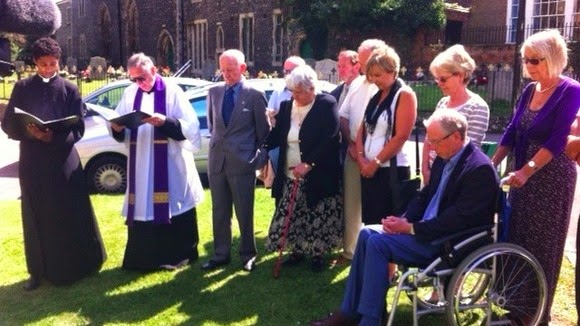
    A memorial service was held today, 13th August 2014, at St. Nicholas Church in Yarmouth to commemorate those who lost their lives on-board G-ASWI 33 years ago

    Among the 11 passengers and two crew who died in the crash off the coast of Happisburgh was 28-year-old Stephen Harvey.

    His parents, Joyce and Paul Harvey, from Gorleston, near Great Yarmouth, have spent the past 33 years campaigning for a permanent memorial to the 13 men who lost their lives.


    The memorial which commemorates those who perished in the crash

    Today, they attended a special ceremony at St Nicholas' Church in Yarmouth, alongside Stephen's wife Jill, when it was finally unveiled.

    "You never ever really get over it, but you just have to learn to live with it and there is not a day goes by that I don't think of him, so it's really nice to be able to put this memorial in place" said Jill Gibling.

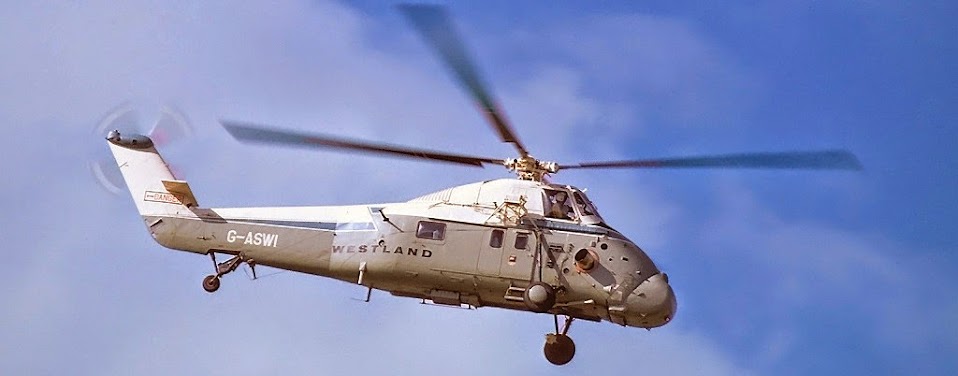
    The Westland Wessex helicopter operated by Bristow Helicopters (G-ASWI) was never fully recovered from the crash site.


    Ambulance crews as seen on standby on 13th August 1981 in Great Yarmouth

    An Inquest at the time recorded an open verdict stating there was insufficient evidence to determine the exact cause of the crash.


    The ill-fated G-ASWI, a Westland Wessex Mk60, as seen at Farnborough on 20th September 1958 while serving as a demonstration aircraft for Westland Helicopters (Photo: Alex Christie)

    Despite many unanswered questions, Stephen's parents said today was, for them, the end of an era and that they felt great relief that the names of the 13 men who died in the tragedy were finally there for all to see.
    http://www.itv.com/news/anglia/2014-...r-disaster/​

    Leave a comment:


  • Aviafora Newsdesk
    replied

    S-92 Landing at Aberdeen

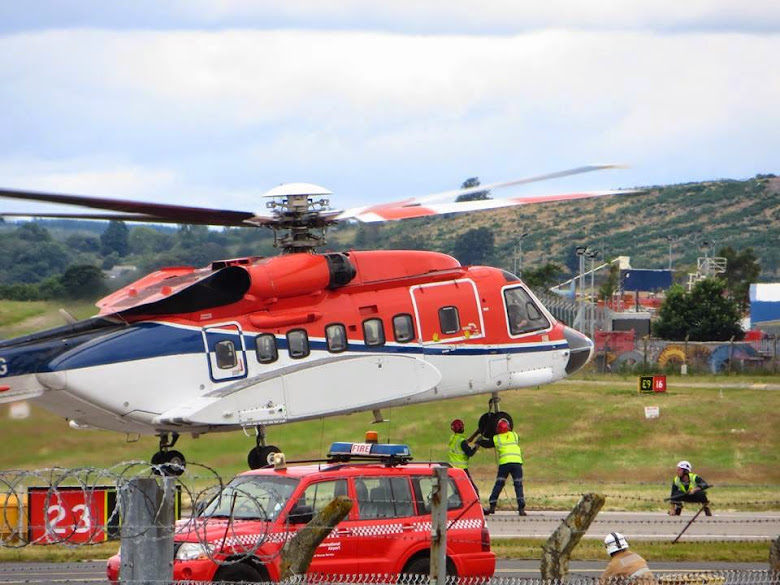
    Earlier this week (Tuesday 29th) a CHC S-92 required the assistance of ground crew when the flight crew failed to obtain a "three greens" confirmation on the status of the aircraft's landing gear.


    A CHC S-92 enters the hover at Aberdeen Airport in order to allow ground crew to assist in releasing the aircraft's nose gear


    A CHC S-92 at Aberdeen Airport having its nose gear manually lowered

    After a fly-by it was ascertained that the S-92's nose gear had not lowered. The aircraft then established a hover so that ground crew could manually pull down the nose gear. This action resulted in the illumination of the "third green".

    Following the manual lowering of the undercarriage the helicopter went on to perform a normal landing and there was no further incident.
    AN.

    Leave a comment:


  • Aviafora Newsdesk
    replied


    Uni-Fly Awarded Wind Farm Contract

    Sweden's Vattenfall Energy has awarded a crew transfer contract to Denmark's Uni-Fly who will provide logistics and construction support as well as an option for medical support services.


    A Uni-Fly EC135

    A further contract option makes provision for Uni-Fly to support Vattenfall's development of the DanTysk farm off the German coast.

    Uni-Fly is based at Hans Christian Andersen airport near Odense on Funen and has previously conducted work at both Horns Rev and Horns Rev 2 wind farms using Eurocopter EC135's.
    http://renews.biz/71038/dong-vattenf...chopper-deals/

    Leave a comment:


  • Aviafora Newsdesk
    replied


    Wiking Awarded Wind Farm Contract

    Denmark's Dong Energy has awarded an emergency medical services support contract to Germany's Wiking Helikopter Service who will supply EMS support for the future and existing offshore wind farm operations.


    A Wiking Helikopter AW109S

    The installations to be covered in the agreement include Gode Wind 1 & 2 and Borkum Riffgrund 1 & 2.

    Wiking will provide these services from their base at Jade Weser Airport near Willemshaven.
    http://renews.biz/71038/dong-vattenf...chopper-deals/

    Leave a comment:


  • Aviafora Newsdesk
    replied


    Bristow Performs First UK AW189 Flight

    Bristow Helicopters has performed the first commercial flight with the new AgustaWestland AW189 super-medium helicopter from its UK, Norwich base.

    Taking place on Monday 21 July, Bristow used the 8.3t rotorcraft to transport eight passengers for customer GDF Suez E&P from its facility in the east of the UK to the Cygnus field in the southern North Sea.


    Offshore workers board Bristow AW189 G-OENA for the first commercial flight of the type

    The helicopter (G-OENA) is the first of two of the type to be stationed at the Norwich site, and will perform the 240nm (444km) return flight once daily. The frequency could be raised to three times per day as the new field develops, says Bristow.

    Bristow has a further four of the General Electric CT7-powered AW189s on order for oil and gas missions, configured in a 16-passenger layout.

    Mike Imlach, managing director, Bristow Helicopters says it is “excited to be the launch customer” for the helicopter, which received EASA certification earlier this year.

    Bristow will also use a fleet of 11 AW189s to perform search and rescue missions in the UK when it takes over the contract from the nation’s armed forces from 2015.

    AgustaWestland have so far taken firm orders for 80 AW189's.
    http://www.flightglobal.com/news/art...ervice-401906/

    Leave a comment:


  • Aviafora Newsdesk
    replied

    Bristow EC225 Forced to Shutdown Offshore

    18 oil workers were left on a North Sea rig after the helicopter due to take them home started leaking fluid, the Evening Express can reveal today.

    The problem with the Airbus EC225 was discovered as the Ensco 102 rig workers queued up to board the helicopter.

    Checks revealed the fluid was leaking both inside and outside the aircraft.


    A Bristow EC225

    And because the workers couldn’t leave, the rig became overcrowded with staff having to bed share.

    Bristow Helicopters today confirmed an Airbus EC225 helicopter had to shutdown on the rig following a “fluid leak”.

    Workers spent an extra two days on the rig waiting for a replacement helicopter.

    A spokeswoman for Bristow Helicopters said: “We can confirm one of our Airbus EC225 helicopters had cause to shutdown on an offshore installation on Thursday at approximately 1pm following a suspected fluid leak.

    “The aircraft underwent a full inspection and was subsequently declared serviceable on July 11th".

    “Flight safety is Bristow’s first priority and we will always investigate prior to further flight.”
    http://www.eveningexpress.co.uk/news...opter-1.472914

    Leave a comment:


  • Aviafora Newsdesk
    replied


    CAA Moves to Performance Based Safety Regulation in Wake of North Sea Accidents

    The UK’s Civil Aviation Authority (CAA) aims to become a performance-based regulator over the next two years following the findings of a report into a series of helicopters accidents in the North Sea, the last of which resulted in four fatalities.

    Following the crash of the CHC Scotia AS332 L2 Super Puma (G-WSNB) on its approach to Sumburgh, in the Shetland Isles, on Aug. 23, 2013, CAA conducted a safety review of offshore public transport helicopter operations serving the oil and gas sector. The ensuing document, CAP145, was published on Feb. 20, 2014.

    Speaking during the first day of the Royal Aeronautical Society’s Technology: Friend of Foe conference (July 3-4) in London, Mark Swan, CAA’s director of Safety and Airspace Regulation, told delegates that his organization wanted to provide performance-based regulation with a focus on risk first. He said that the CAA was six months into a two-year process.

    Human factors were key and Swan questioned whether technology complexity issues were being sufficiently addressed by the industry and operators. He said that fatalities should never be “normalized” and the immediate reaction after Sumburgh was to address the issues raised, particularly with regard to human factors.

    Swan said that the driving force behind producing a quick report had been to get safety measures introduced in the shortest feasible time. There had been several positive results from CAP1145 and the discussions within the Helicopter Safety Action Group, which comprised manufacturers, operators and other specialists: it produced a strong stance on safety; initiated real changes to improve safety; and improved communication to the industry.
    One of the results was that the Emergency Breathing System (EBS) for passengers would begin being rolled out from July this year and be compulsory from January 2015.

    The RAeS Technology conference, largely created by longstanding member Jim Lyons of the RAeS’ Rotorcraft Committee, gathered together a wide range of industry operators and rotorcraft specialists to discuss whether the increasing complexity of helicopter avionics is providing crews with a wider range of benefits or contributing to human factor issues.

    Representatives from a range of operators provided presentations, including CHC, Bristow and Bond, together with others who addressed the complexity of helicopters.

    Two speakers, Capt. Lloyd Watson of Shell Aircraft International and Capt. Mark Cameron of Emirates Airlines, drew on lessons learned by the fixed-wing industry and suggested that some could be transferred over to the rotorcraft sector. Watson said that safety was compromised as systems increased in complexity away from being user friendly. He said that the introduction of new technology required training so that the impact could be reassessed and that some complex systems could increase workload rather than simplify procedures for the aircrew.

    Cameron added: “Exotic devices create exotic problems,” and stressed the need for the aircrew to be constantly aware of what the aircraft would do next, rather than retreat from the areas that the avionics were taking over. “Pilots still need airmanship,” he said, adding that they are required to retain their resilience, suspicion and airmanship.
    http://www.aviationtoday.com/the-che...l#.U74zk5SSwnk

    Leave a comment:


  • Aviafora Newsdesk
    replied


    Helicopter Crew 'Feared Autopilot Error'

    An incident report on the events surrounding the dangerous descent of a Dancopter EC155 on 6th November 2013 in the North Sea has concluded that the pilots mistakenly thought the aircraft was not performing correctly. The helicopter was carrying eight gas platform workers and had descended to within 50ft of the water.

    The pilots' incorrect assumption was due to a "combination of technical and organisational factors, which led them to depart from normal operating parameters", the report said.


    The Dancopter EC155B1 which was involved in the incident

    The two-man crew "clearly believed the autopilot was not functioning correctly both during and after the event", added the report from the Air Accidents Investigation Branch (AAIB).

    The captain's decision to select an exaggerated nose-down attitude just after the Eurocopter EC155B1 aircraft had taken off from the Clipper gas production platform in the southern North Sea was "made out of concern for the helicopter's apparently poor performance".

    This arose "because of the weighing and fuel gauging errors which had existed undetected for some time".

    The high rate of descent, in which airspeed reduced below 20 knots (about 23mph) was arrested about 50ft above the sea surface and the captain climbed to normal cruise height, with the helicopter landing at Norwich airport. Described by the AAIB as a "serious incident", the events occurred on the evening of November 6 last year - weeks after four people died in a North Sea Super Puma helicopter accident.

    The report said the effect of the weighing and fuel gauging errors was "a major influence on the commander's subsequent actions". The AAIB said a number of safety actions had since been taken.
    http://www.aviationtoday.com/the-che...U74zk5SSwnk​

    http://www.aaib.gov.uk/publications/...b1__oy_hjj.cfm

    http://www.dancopter.dk/en

    Leave a comment:


  • Aviafora Newsdesk
    replied


    MPs Demand Public Inquiry into Safety of Helicopters for Offshore Rig Workers

    The safety of helicopters transporting workers to offshore rigs must be scrutinised at a full public inquiry, MPs have demanded, questioning the role of the regulator and checking a "creeping complacency" in safety standards.

    The transport select committee said in a report published on Tuesday the inquiry should address whether commercial pressure from oil and gas companies was putting workers at risk.

    The Civil Aviation Authority conducted a wide-ranging review of offshore helicopter operations after a series of accidents and incidents in the North Sea, culminating in the crash of a Super Puma, killing four, last August near Shetland. It reported in February with a range of recommendations to improve safety on flights.


    An S-92 helicopter on a Forties Field platform

    However, Louise Ellman, chair of the transport committee, said serious questions remained unanswered. She said: "After four accidents in five years, offshore workers' confidence in helicopter safety is understandably low. Despite work by the CAA, serious questions remain unanswered about offshore helicopter safety in the competitive commercial environment of the North Sea. We fear a creeping complacency may be affecting safety standards.

    "The role and effectiveness of the CAA has not been adequately examined. Only a full and independent public inquiry would have the power and authority to investigate properly."

    "Workers in the offshore industry have the right to know everything possible is being done to keep them safe. We call for the CAA to ensure that helicopter operators review all safety arrangements to guarantee all are fit for purpose."

    In the report, the committee said that regulatory inertia at the European Aviation Safety Agency was exposing offshore workers to unnecessary risk by slowing down the implementation of safety improvements, and demanded that the government push the agency to make changes recommended by accident investigators rapidly and transparently.

    The report said there was evidence of "a macho bullying culture" in the oil and gas industry, which had seen workers told to work elsewhere when they raised concerns about helicopter safety.

    It also recommended that the Air Accident Investigation Board keep crash survivors better informed on the progress of its investigations in future.

    The CAA responded to the committee's criticism by saying that safety improvements were being implemented as a priority. It said: "Any loss of life in aviation accidents is always tragic and the safety of those who rely on offshore helicopter flights is therefore our absolute priority.

    "In February we announced over 70 actions and recommendations to improve safety, primarily aimed at preventing accidents, but also to improve survivability following an incident. These were widely welcomed by unions, helicopter operators, the oil and gas industry and Norwegian regulators and are bringing significant improvements in safety for those flying offshore in the UK and potentially worldwide.

    "The new CAA-led Offshore Helicopter Safety Action Group is ensuring operators and industry implement these changes as quickly as possible. It has already overseen the approval of a new significantly enhanced underwater emergency breathing system for offshore workers. This new system will be rolled out across the UK offshore industry this summer and autumn, with accompanying training."


    The pilots' union Balpa welcomed the MPs' report. Its general secretary, Jim McAuslan, said it added "further weight to the urgent need for safety improvements". He said: "Pilots are working with the CAA and operators to improve helicopter safety offshore and support the committee's call for a public inquiry. This should examine issues highlighted in the report including the safety risks of commercial pressure on operators and ensuring the CAA retains full control over regulating offshore flights rather than delegating to an ill-equipped European regulator."
    http://www.theguardian.com/uk-news/2...fshore-crashes

    Leave a comment:


  • Aviafora Newsdesk
    replied


    Bond to Be Sued for Puma Ditching

    ​Oil workers on a Super Puma which ditched into the North Sea have launched legal action against the helicopter operator.

    A total of 10 of the 14 people on board the aircraft at the time are suing Bond Offshore Helicopters Ltd.


    Passengers on the bond helicopter wish to receive compensation similar to that which is expected to be paid out to passengers on board a CHC Puma in the same year

    Everyone on the Bond EC 225 Super Puma survived the ditching, which happened 30 miles east of Aberdeen in May 2012.

    Now 10 of the workers have lodged actions at the Court of Session in Edinburgh.

    Lisa Gregory, who is representing the crew members, confirmed her clients had started legal proceedings against Bond.

    The men taking action are Simon Borton, of Renfrewshire; Peter Clementson, of Portlethen; James Foreman, of Montrose; Kris Green, of Huntly; Jason Haylett, of Great Yarmouth; Raed Mansour, of Edinburgh; David McCarroll, of Liverpool; Sergejs Novikovs of Balozi, Latvia; Matthew Ralph, of Bristol; and William Strachan, of Fraserburgh.

    No one from Bond was available to comment.
    http://www.eveningexpress.co.uk/news...ching-1.455097

    Leave a comment:


  • Aviafora Newsdesk
    replied
    Airbus Accepts Liability for 2012 CHC Ditching


    The CHC-operated Super Puma EC225 was forced to land in the North Sea between Shetland and Orkney off Fair Isle.

    Lawyers working for Irwin Mitchell have said manufacturer Airbus, formerly Eurocopter, accepts that it is “solely responsible for failures” leading to the crash.

    An Irwin Mitchell spokesman said: “Lawyers at the firm have now received written confirmation from Airbus Helicopters stating that it accepts that it is solely responsible for the failures which led to the crew ditching the aircraft causing both physical and psychological injuries to those on board.”

    The Super Puma was forced to ditch due to a failure in the gearbox lubrication system and a false warning in the emergency lubrication system.


    The ditching of the Airbus helicopter was said to have been traumatic for those involved

    The helicopter was flying from Aberdeen to the West Phoenix platform, west of Shetland when it ditched. Two crew were also on board the helicopter.

    Jonathan Garcia, an ROV Pilot Technician on board when the helicopter ditched, said: "It has been a long wait for answers regarding the incident but, if any good is to come of it, it will be that steps are taken to improve offshore helicopter safety in the long term.

    "Barely a day goes by when I do not think of the ditching. It was incredibly traumatic. Thankfully now that Airbus Helicopters has accepted responsibility, we should be able to start moving forward and receive the help and support we need to be able to move on with our lives.

    “I hope that the aviation authorities and helicopter operators take the necessary steps to prevent anyone else going through what I have had to experience."

    Jim Morris, a former RAF pilot and partner in Irwin Mitchell's Aviation Law team, added: “There have been a number of adverse incidents involving Super Puma helicopters in recent years. We now hope that the issues identified in the recent accident report are fully addressed as soon as possible to prevent any similar incidents in future.”
    http://news.stv.tv/north/281562-lawy...esponsibility/

    Leave a comment:


  • Aviafora Newsdesk
    replied
    North Sea Suicide From CHC Helicopter


    A Swedish man has died after jumping from a CHC helicopter into the North Sea while being taken to hospital in Norway, Norwegian police said on Thursday.

    The 37-year-old man jumped while the helicopter was more than 600m above the water on Wednesday morning. It is believed that he committed suicide according to sources close to the investigation.

    "During the flight the man climbed out of the helicopter's emergency exit," said Thomas Soerensen at the Sotra, Askoey and Oeygarden police station. "He fell into the sea, 600m below and we believe he died on immediately."

    The man was working on Statoil's 'Troll A' platform located 65km off the west coast of Norway when he complained of being ill and was being taken to a hospital in the western city of Bergen.


    Police said they were investigating the circumstances surrounding the death.

    Sources close to the investigation told AFP that the deceased had been suffering from psychological problems.


    Press Contact Svein Thompson in CHC Helikopter Service says that the incident came as a shock. "This is a type of tragedy we've never experienced before. We now think of the man's family" said Thompson.
    http://www.thelocal.se/20140703/swed...-helicopter​

    http://www.offshore.no/sak/61699_pas...fra_helikopter

    http://www.news24.com/World/News/Swe...er-20140703​

    Leave a comment:


  • Aviafora Newsdesk
    replied
    Statoil Awards Mariner Field Contract to CHC


    Statoil UK has awarded a helicopter transportation contract for the Mariner Field to CHC Helicopters.

    The contract calls for CHC to operate two Sikorsky S-92 aircraft on behalf of Statoil. The helicopters will fly from Aberdeen and Sumburgh on the Shetland Isles to the Statoil operated Mariner Field, 250 kilometres off the northeastern coast of Scotland.

    The contract has a duration of five years, plus an extension option for up to three years. The service is anticipated to begin in mid-2016.

    "We are pleased to have entered into this contract, meeting our needs for safe and efficient transportation to the Mariner Field, our first operated field development on the UK Continental Shelf (UKCS)," said Gunnar Breivik, managing director of Statoil Production UK and head of the company's Aberdeen office.

    "We will have substantial offshore activity as the Mariner project enters the hook-up and commissioning phase in 2016 and production starts in 2017," said Mr. Breivik. "We are also pleased with the flexibility in the contract, including options for servicing our exploration activity and possible expansion on the UKCS."

    CHC Helicopter Regional Director Mark Abbey said the award recognises the safe and reliable service that CHC has provided to Statoil over a number of years, from a number of locations around the world.

    "We're proud to partner with Statoil as they start up operations in the UK sector," said Mr. Abbey. "Our pilots, engineers and support teams will be using their extensive experience of the North Sea environment to help Statoil to go further, do more in the Mariner field, and come home safely".

    Mariner is the largest field development on the UKCS in more than a decade, with a gross investment of more than US$7 billion. The field is located on the East Shetland Platform of the UK North Sea. The development of the Mariner Field will contribute more than 250 million-barrels reserves, with average plateau production of around 55,000 barrels per day. The field will provide a long term cash-flow over a 30-year field life.
    http://online.wsj.com/article/PR-CO-...18-902550.html

    Leave a comment:


  • Aviafora Newsdesk
    replied
    Norway Shuns UK Offshore Helicopter Safety Changes


    Authorities in Norway have criticised some of the changes to the UK's offshore helicopter industry which are being introduced this week.

    The Norwegian Civil Aviation Authority (NCAA) said it has no plans to duplicate the 32 safety improvements planned for Scottish offshore helicopters.

    The Scandinavian country has not seen a serious helicopter crash since 1998. Over the same period there have been five crashes in UK waters.

    Since a helicopter crash last year off Shetland, in which four people died, UK aviation authorities have been looking to improve safety.

    In response, the Civil Aviation Authority (CAA) published a report which contained 32 improvements but the NCAA is not planning to replicate any of them.


    Roy Erling Furre, second deputy leader with the Safe Union which represents oil workers, said: "I think people would be more worried about working in the UK sector."

    Geir Hamre, NCAA head of helicopter safety, believes some changes, like restricting seat numbers, might actually compromise safety.

    He said: "That will mean that we need to fly earlier in the morning and later at night, which is something we don't like when we have the kind of weather we have and darkness. "We want as little flying at night as possible." The CAA said it hopes night flying can be avoided altogether because of other changes being introduced.

    One of those modifications includes replacing what is effectively a bag, where the passenger of a ditched helicopter re-breathes their own air, with a pressurised can of oxygen attached to their suits.

    Mr Hamre added: "You never like to have pressurised systems in a helicopter that you don't control. Because it's pressurised, it can cause accidents if it explodes or its not treated the right way."

    'Find common solutions'

    The safety report has not been wholly criticised by the Norwegians though with some claims it represents a move towards the Norwegian model.

    Andreas Saetre, from the Norwegian pilots union (Nalpa), said: "There are some good points in this report and we would definitely look into it in the next meetings and debate it but we need to evaluate them to make sure that they have the desired outcome."

    A "tripartite" forum for discussing safety, involving the companies, unions and the regulator, is being replicated back home.

    It is the backbone of the safety culture in Norway but unions have more powers and the framework for the forums are grounded in the law.

    Prof Ole Andreas Engen, from the University of Stavanger, said: "One of the things that I think works fairly well is the tripartite system where you can negotiate and find common solutions you agree upon. "I think that is a tremendous and powerful instrument in order to improve safety."
    http://www.bbc.co.uk/news/uk-scotland-27655115

    Leave a comment:


  • Aviafora Newsdesk
    replied
    Bristow S-92 Overnights on 'Alba' Following Fuel Leak


    A HELICOPTER carrying oil workers was grounded on a North Sea ship overnight when a fuel leak was found.

    The Bristow S-92 landed on Alba Floating Storage Unit (FSU) on May 28 and was prevented from returning to the mainland the same day after the "technical issue" was discovered.

    The aircraft was carrying seven passengers and two crew when it landed at 5pm for a staff switch.


    A Bristow S-92

    A series of measures aimed at improving offshore helicopter safety were announced by the Civil *Aviation Authority in the wake of a fatal Super Puma crash last year.

    A source who works on the FSU, which operates in an oil field 130 miles north-east of Aberdeen, said that when the helicopter came in the fault was noted and an engineer was deployed to fix the problem.


    The Alba Floating Storage Unit

    He said: "It was leaking badly when it was on the ground and there was no thrust, so even more fuel would have come out if it was airborne.

    "If it wasn't noticed when it was landed, that helicopter would have gone down, no question."

    A spokeswoman for oil giant Chevron, which runs the FSU, said: "A helicopter was temporarily retained on the Alba FSU platform as a precautionary measure as a result of a technical issue which has been resolved."

    Bristow Helicopters confirmed one of its S-92 models was shut down on the offshore installation "as a precautionary measure".

    A spokeswoman said: "Following functional tests and in consultations with the Aircraft Manufacturers and Regulatory Authorities, the aircraft was declared serviceable and cleared to complete its scheduled return flight to Aberdeen."
    http://www.heraldscotland.com/news/h...-leak.24364870

    Leave a comment:


  • Aviafora Newsdesk
    replied
    Feedback from the EC175's North Sea Tour

    Including comments from Bristow Training Captains Steve Armstrong and Simon Tickel and CHC Training Captain Hugh Martin:

    Leave a comment:


  • Aviafora Newsdesk
    replied
    EC175 to Commence North Sea Demonstration Tour


    Airbus Helicopters will begin a week-long demonstration tour of their EC175 bringing the rotorcraft to England, Scotland and Norway, starting Monday 19th May.

    It will demonstrate its outstanding Category A performance and its mission capabilities for the oil and gas sector during a three-nation demonstration tour starting this coming Monday.

    In conjunction with the new rotorcraft’s tour of the North Sea, Airbus Helicopters will announce an increase to the EC175’s maximum take-off weight, up to 7,800 kg, offering significant additional payload of 300 kg or an additional 40NM radius of action. The extended MTOW provides additional operational flexibility – particularly in highly demanding oil and gas heli-lift operations, and for missions to oil rigs that are located increasingly further off-shore. Certification of the extended maximum take-off weight is planned before the end of 2016, following a flight test campaign next year.


    EC175 to tour North Sea operators next week

    “Seeing is believing, and this latest EC175 demonstration tour will enable North Sea oil and gas operators, oil companies and industry workers’ unions to experience and appreciate the performance, range and comfort of this new-generation helicopter,” said Dominique Maudet, Airbus Helicopters’ Executive Vice President - Global Business and Service.

    The EC175’s demonstration tour brings it to Norwich, England on May 19th; Aberdeen, Scotland during May 20th – 22nd, and Stavanger, Norway, on May 23rd.

    Certified in January by the European Aviation Safety Agency (EASA), Airbus Helicopters’ EC175 meets the latest airworthiness standards, covering both the rotorcraft and its new Helionix® avionics suite – which provides increased safety through reduced pilot workload, enhanced situational awareness, improved flight envelope protection and system redundancy.

    The helicopter was developed to meet evolving oil and gas industry mission needs, offering outstanding performance and unmatched cost efficiency – enabling a full payload to be carried to 90 percent of the North Sea’s offshore installations. The Rig ’N Fly GPS-navigation-assisted software, after certification on EC225e, will be incorporated in the EC175’s avionics suite to make approaches to, and takeoffs from, platform-based helipads safer and simpler.

    As a high-capacity medium-sized rotorcraft, the EC175 accommodates 16 passengers in comfort, offering the most cabin volume per person. The in-flight environment is enhanced by very low vibration levels and a smooth ride – even at high speed. Powered by Pratt & Whitney Canada’s latest PT6 engine – the PT6C67E version developed specifically for this helicopter – the EC175 retains a competitive edge with its recommended cruise speed of 150 kts., while the maximum cruise speed exceeds 165 kts.

    Airbus Helicopters will begin EC175 deliveries later this year to the first customers, backed by the company’s commitment to provide a mature helicopter with a dedicated task force and tools that include validated support and services deliverables, as well as established training capabilities.

    As part of its investment in support and services resources, Airbus Helicopters has installed an EC175 Level D full flight simulator at its Marignane, France headquarters for operation beginning this summer, allowing pilot training to begin prior to the start-up of EC175 deliveries.

    Airbus Helicopters operates a facility in Aberdeen, Scotland offering 930 square meters of storage volume for spares, along with local maintenance, repair and overhaul capability. This support capacity reduces turnaround times and increases operational productivity for customers in the North Sea.
    http://www.adsadvance.co.uk/airbus-h...demo-tour.html

    Leave a comment:


  • Aviafora Newsdesk
    replied
    North Sea Workforce Grows

    Britain’s North Sea workforce grew by 8.6% last year, despite pressures on the sector from helicopter safety issues and a fall in the price of oil.

    A study by industry body Oil & Gas UK found the number of people working on platforms in the North Sea had hit its highest recorded level, with a total of almost 62,000 flying out for at least one night during 2013.

    The workforce is getting younger, with a near 15% hike in those aged between 23 and 28, and the average age of offshore workers falling to below 41.

    But the study also found massive under-representation of women in the offshore workforce at a time when the sector is crying out for skilled new recruits.


    Women now comprise 3.6% of the total “offshore population”, representing a decrease of almost 0.2% since 2012​

    The trade body said the rate of increase was stronger than had been anticipated given the effect on transport capacity following a ditching in October 2012 and a suspension of services following a fatal crash off Shetland in August last year.

    It also hailed the impact of billions of pounds of investment in new projects during a year in which the average price of a barrel of oil fell $3 to $109.

    “Between 2010 and 2013, there was a sharp rise in the number of offshore personnel.

    “However, upon analysing the data, there does not appear to be a significant increase in any particular discipline or area of offshore work,” the demographics report said.

    “The rise in manpower could be attributed to maintenance programmes, upgrades and key projects taking place in 2013, together with record capital investment of £14.4 billion in the industry.”

    Oil & Gas UK employment and skills manager Alix Thom said the statistics helped to dispel the “common misconception” of an ageing workforce.

    “However, this good news must be considered against the 8% reduction in production seen in 2013 and the fact that there has been a slight drop in the proportion of female employees relative to the total offshore population,” Dr Thom said.

    “Women now comprise 3.6% of the total offshore population, representing a decrease of almost 0.2% since 2012.

    “Given the current level of demand for skilled employees, and the high level of activity on the UK Continental Shelf, it is in the industry’s interest to increase its focus on tackling this lack of gender diversity as it represents a significant, but not fully utilised, pool of talent.”

    The number of so-called “core” staff — who spend more than 100 nights offshore each year — rose 7.7% to 27,750, accounting for 6% of the UK industry’s workforce.

    The core figure represents 45% of the total employment in the sector and saw a 7.7% increase on the same measure in 2012. Of the core, half visited a single offshore site, with 72% working for a single operator.

    Just more than four-fifths were British, with the largest proportion of non-British workers coming from Norway.

    But the proportion of female workers in the workforce, 30% of whom are in catering, fell marginally on the previous year’s level.
    http://www.thecourier.co.uk/business...force-1.367863

    Leave a comment:


  • Aviafora Newsdesk
    replied
    UK CAA Changes North Sea Safety Measures Timescale


    The UK Civil Aviation Authority (CAA) has announced changes to two of its requirements aimed at improving offshore helicopter safety. It follows discussions with the oil and gas industry, helicopter operators and representatives of the offshore workforce and pilots.

    In February the CAA announced a series of measures to improve the safety of offshore operations. These included the introduction of seating restrictions on offshore flights from 1 June 2014, only allowing passengers to fly if they are seated next to a push-out window exit so they can escape in an emergency. This would be an interim measure until improved emergency breathing equipment is provided.

    Since February, the new Offshore Helicopter Safety Action Group, set up by the CAA, has been working to develop the recommendations and oversee their implementation.

    The regulator said that new information had led it to delay the implementation of the seating restrictions until 1 September 2014. Reasons for the change include:

    • Evidence provided by the oil and gas industry that reducing helicopter capacity through seating restrictions could have an adverse impact on safety critical maintenance work due to take place at offshore installations over the summer.

    • Confirmation that the first improved breathing system units – which would remove the need for seating restrictions - won’t be available before mid-July.

    • The recent certification of a redesigned gear shaft for the Airbus Helicopters EC225 – enabling it to be fitted on existing helicopters of this type. The CAA said that this is an important safety modification which should be implemented as quickly as possible, but will also require helicopters being temporarily taken out of service, further reducing capacity at this busy time for offshore safety maintenance.

    The second change is to significantly bring forward the date from which the improved Emergency Breathing System (EBS) will be compulsory. This will now be 1 January 2015 rather than 1 April 2016. The new system will deliver a significant improvement in safety for those travelling offshore and is expected to gain safety approval this month.

    CAA Head of Flight Operations Rob Bishton said: “The safety of those who work offshore is our absolute priority and as such we must also consider their safety on offshore installations as well as onboard flights.

    “We have listened carefully to the views of the industry, the unions and the helicopter operators. The changes to timescales we have announced today will mean that helicopter flights will only be permitted after 1 January 2015 if passengers are fitted with the improved emergency breathing equipment – that’s much earlier than originally planned. But we are also giving the industry an extra three months before the temporary seating restrictions are applied, so that they can complete planned, safety-critical maintenance work offshore over the summer.”

    The CAA said that it also understood workforce concerns about its plans to prevent helicopter operators carrying passengers whose body size means they couldn’t escape through push-out window exits in an emergency. The change, which is not due to take effect until 1 April 2015, is to ensure that everyone onboard can escape in the event of a helicopter capsizing after a ditching or water impact. The Offshore Helicopter Safety Action Group has said that the introduction of the requirement will be sensibly managed and the Group’s aim is that no one loses their job as a result of the change. Exit sizes vary from one helicopter type to another - and even from one seat row to the next on some helicopters - and there are many options being explored, especially around seat allocation.
    http://www.caa.co.uk/application.asp...etail&nid=2358

    Leave a comment:


  • Aviafora Newsdesk
    replied
    Precautionary Return to Base: Aberdeen


    A Super Puma EC225 carrying 17 passengers to the Talisman’s Clyde platform returned to Aberdeen today after the illumination of a warning light on the helicopter's instrument panel.

    The helicopter had been in the air less than 20 minutes when the incident occurred. The Super Puma returned to Aberdeen International Airport at around 10.30am on Thursday 1st May.

    Operator Bristow says the aircraft will undergo checks before it is allowed to fly again. A spokeswoman said: "Flight safety is Bristow’s first priority and we will always investigate prior to further flight."
    http://news.stv.tv/north/273611-supe...y-to-clyde/​

    Leave a comment:


  • Aviafora Newsdesk
    replied
    Inquest to be Held for G-REDL First Officer


    An inquest into the death of Richard Menzies, who died when the helicopter he was co-piloting crashed into sea off the Aberdeenshire coast on April 1, 2009, will take place on July 24 2014.

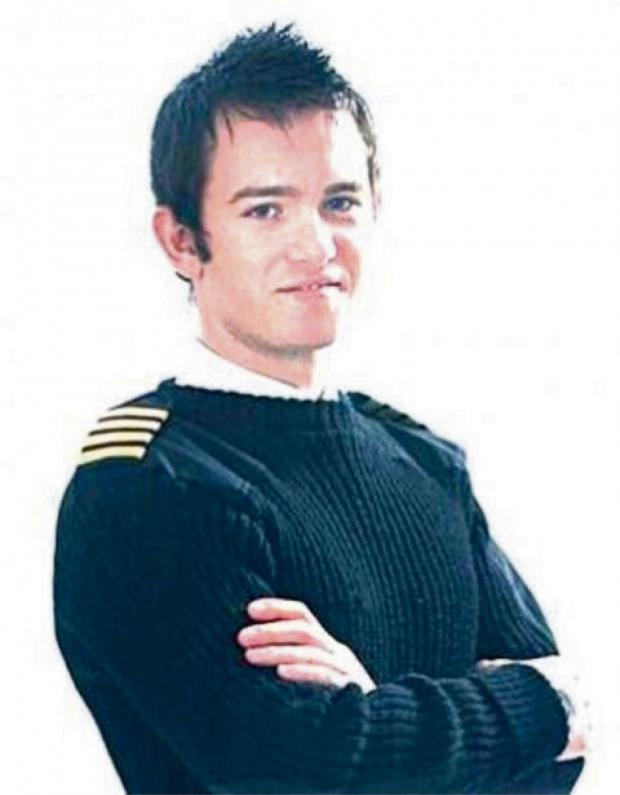
    Mr Menzies, who was 24 when he died, a former pupil at Pershore High School and hailed from Droitwich, was among 16 men who died when the Super Puma, operated by Bond Offshore plumeted into the North Sea five years ago.


    Richard Menzies, 24, was First Officer on board the stricken helicopter

    A fatal accident inquiry (FAI) held before Sheriff Principal Derek Pyle earlier this year found the tragedy might have been avoided if proper maintenance had been carried out.

    Despite this the Crown Office said the company would not be prosecuted as failings could not be proved beyond reasonable doubt.


    G-REDL, the AS332L Super Puma which crashed in the North Sea 11 nautical miles northeast of Peterhead just before 2:00 pm on 1 April 2009

    An earlier Air Accidents Investigation Branch (AAIB) probe found that the aircraft suffered a "catastrophic failure" of its main rotor gearbox.

    Speaking after the findings earlier this year, a spokesman for Bond Offshore said the firm accepted it had made mistakes and lessons had been learned.

    The inquest is set to take place at the Worcestershire Coroners Court in Stourport at 11am on July 24.
    http://www.worcesternews.co.uk/news/...in_2009_crash/

    Leave a comment:


  • Aviafora Newsdesk
    replied
    Precautionary Landing: Sumburgh


    A Bristow EC225 has made a precautionary landing at Sumburgh Airport in response to a technical warning which occurred in flight.

    The Airbus Super Puma alerted the airport control tower at around 10.50am after a warning light was triggered and thereafter landed safely at around 11am with all 18 passengers and two crew reported as being safe and well.


    A Bristow EC225 Super Puma

    The airport fire services, ambulance crews and police were all scrambled, while the Sumburgh-based Coastguard rescue helicopter was put on standby.

    A Bristow spokesman said: “Bristow Helicopters Ltd can confirm that one of its Airbus EC225 helicopters was diverted to Sumburgh Airport today at approximately 10.50am after a caution light illuminated in the cockpit.

    “The aircraft was undertaking a routine crew change flight to an offshore installation and had 18 passengers and two crew on-board at the time.

    “The aircraft landed safely at Sumburgh Airport at approximately 11am and is currently undergoing a fault diagnosis to establish the required maintenance actions.

    “The landing itself was uneventful but Sumburgh Airport mobilised the emergency services as a matter of routine.”

    He added: “Flight safety is Bristow’s first priority and we will always investigate prior to further flight.

    A spokesman for Highlands and Islands Airports, who operate Sumburgh Airport, said: “There was an incident involving a Bristow helicopter at Sumburgh Airport this morning.

    “The aircraft landed safely and the incident was quickly stood down. In line with standard procedures, HIAL’s airport fire service were on standby but were not required.”

    The warning light which illuminated on the aircraft's instrument panel during flight is believed to have been related to the helicopter's main gearbox.
    http://www.scotsman.com/news/transpo...lert-1-3392361

    Leave a comment:

Working...
X